Skip to content

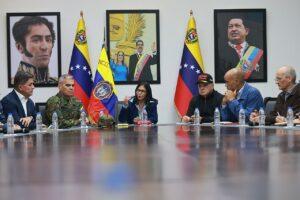
In a dramatic reshaping of Venezuela’s political landscape, Delcy Rodríguez has been sworn in as the country’s interim president following the capture of Nicolás Maduro in a U.S.-led military operation. The move consolidates Rodríguez’s rapid ascent from vice president and oil minister to the nation’s top office at a time of extreme tension between Caracas and Washington.
Rodríguez took the oath of office on 5 January 2026, just two days after U.S. forces seized Maduro in Caracas, an event that Venezuelan authorities have condemned as a violation of sovereignty. The swearing‑in ceremony, held under tight security in the capital, was framed by state media as a constitutional step to guarantee continuity of government amid what officials described as an “external aggression.”
The Supreme Tribunal of Justice, widely viewed by critics as loyal to the ruling establishment, issued the ruling that cleared the way for Rodríguez to assume full presidential powers. Government-aligned judges argued that the abrupt removal of Maduro created an “extraordinary situation” that required immediate action to preserve institutional stability and national defense.
Opposition figures, however, have questioned both the legality and legitimacy of Rodríguez’s elevation, pointing to constitutional provisions that normally require fresh elections if the presidency is permanently vacated. Several opposition leaders maintain that any transition must be grounded in a transparent timetable for free and fair elections, warning that an open‑ended interim administration risks entrenching yet another unelected leadership.
International reaction has been swift and divided, with some governments signaling a wait‑and‑see approach while others refuse to recognize Rodríguez as Venezuela’s legitimate head of state. Diplomatic statements have focused on the twin challenges now confronting the country: navigating its relationship with the United States after the raid, and addressing the deep political fragmentation that predated Maduro’s capture.
In her first public remarks as interim president, Rodríguez balanced a message of defiance with gestures of pragmatic engagement. She denounced the U.S. operation as an “assault” on Venezuela’s sovereignty, even as she indicated a willingness to establish “respectful” channels of dialogue to avoid further escalation and to ease the country’s severe economic pressures.
Behind the scenes, analysts say the new leader will have to manage competing expectations from powerful domestic factions as well as foreign stakeholders. Hardliners within the ruling elite are pressing for a firm line against Washington, while other actors see in Rodríguez’s rise a chance to negotiate sanctions relief and re‑open avenues for international investment, particularly in the oil sector.
For ordinary Venezuelans, the shake‑up at the top has brought a mix of uncertainty and cautious hope. Many citizens, already worn down by years of economic crisis, sanctions, and political standoffs, are watching closely to see whether Rodríguez’s interim government will deliver meaningful changes or simply extend the status quo under a new face.
As the new administration settles in, key questions remain unresolved: whether and when new elections will be called, how far the interim leadership will go in restructuring state institutions, and what conditions, if any, the United States will set for revising its policy toward Caracas. The answers are likely to determine not only Rodríguez’s political future but also the broader trajectory of Venezuela’s long‑running crisis.